
(covers information from several alternate timelines)
Mars, also known as Sol IV, was the inhabited fourth planet of the Sol system. It was located near to the asteroid belt. (TOS: "The Cage", "The Changeling"; VOY: "One Small Step")
Mars was one of humanity's oldest colony worlds and the location of Utopia Planitia Fleet Yards, a massive Starfleet shipbuilding facility. Many of the Federation's most famous starships were built here, including the USS Enterprise-D, the USS Defiant, and USS Voyager. (ENT: "Terra Nova"; TNG: "Booby Trap"; DS9: "The Search, Part I"; VOY: "Relativity")
On April 5, 2385, the planet was attacked by rogue synths, who destroyed the Utopia Planitia shipyards and bombarded Mars so heavily that they ignited flammable vapors in its stratosphere. The planet continued to burn well into 2399. (ST: "Children of Mars"; PIC: "Remembrance")
Planetary data[]
Mars was a terrestrial planet about half of that of Earth's radius with a thin atmosphere. The reddish-orange color of the Martian surface, known as Martian red, was due to the presence of iron oxide, also known as hematite. (VOY: "Lifesigns")
Location[]
In the late 19th century, the orbit of Mars was depicted on a German map of the inner system. (Star Trek: Enterprise opening credits)
In 2024, the position and orbital path of Mars were depicted on a map of the Solar System, which was seen at the gala held for the Europa Mission astronauts. (PIC: "Two of One")
In 2254, the orbit of Mars was depicted on a map of the inner system, that was stored in the USS Enterprise library computer. It was one of the records scanned by the Talosians. (TOS: "The Cage" production art)
In 2267, the orbit of Mars was depicted on "Chart 14A: The Sol System" that was stored in the Enterprise library computer. The chart was scanned by the probe Nomad in auxiliary control. (TOS: "The Changeling" production art)


History[]
Before the invention of the telescope, Humans discovered Mars in the night sky. (TNG: "Loud As A Whisper" okudagram)
Mars was a common topic of fantastic literature and scientific speculation. In 1947, several members of the United States military thought Quark, Rom, and Nog were from Mars. Jeff and Garland wondered if they might be able to have their honeymoon there. (DS9: "Little Green Men", "Far Beyond the Stars")
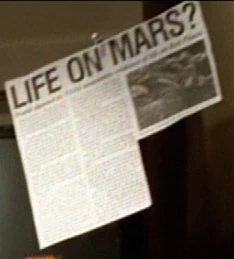

Life on Mars?
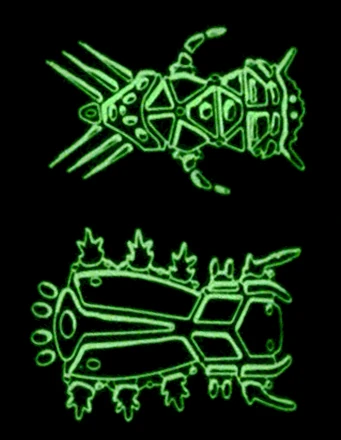

Fossil remains of Martian insects
In an alternate 1996, Rain Robinson had a newspaper article on display in her office showing a picture of a meteorite and asking if there was life on Mars. (VOY: "Future's End") Eventually, fossils of insects were found. (TNG: "The Last Outpost", "Datalore" production art) In the early 21st century, a small group of Human scientists had formed a school of thought that believed Earth's lifeforms originated from Mars. They believed that life was carried from one world to another on rocks blasted off into space by comet or asteroid impacts. This idea was known as lithopanspermia. (PIC: "Two of One")
This planet was explored by unmanned NASA spacecraft in the twenty-two years that followed the launch of Sputnik in 1957. (TNG: "Loud As A Whisper" okudagram; VOY: "11:59")
In 1997, the NASA rover Sojourner became the first vehicle of its type to explore Mars; the location later became a Mars Heritage Site. (ENT: "Demons")
Completed in 2012, the Millennium Gate would go on to serve as a model for the first colony on the red planet. It pioneered many new technologies and scientific principles like a coverage by highly-reflective solar panels and being constructed as a self-contained biosphere. (VOY: "Lifesigns", "The 37's", "11:59")
During the Europa Mission of the late 2020s, the Shango X-1 got a gravity assist from Mars on its way toward Jupiter's moon Europa. (PIC: "Two of One")
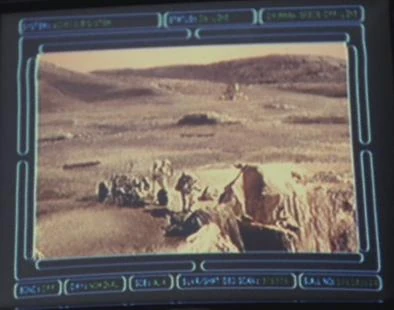

Kumagawa and Novakovich on the surface of Mars
By 2032, a manned Mars program existed. That year, the Ares IV mission took place under the command of Lieutenant John Kelly. Rose Kumagawa and Andrei Novakovich went down to the surface to study various aspects, such as an underground lava flow. Kelly however along with the command module in which he was orbiting the planet, was engulfed by a graviton ellipse while the other two crewmembers were stranded on the planet's surface. A rescue ship arrived two weeks later. (VOY: "One Small Step"; ENT: "Demons")
One of Tom Paris' ancestors piloted the first orbital glider over the lower Martian plateau. Prior to 2069, Utopia Planitia was built on Mars. (VOY: "11:59"; ENT: "Terra Nova")
The Martian colonies were established in 2103. The Fundamental Declarations of the Martian Colonies were passed in or around this date. (VOY: "The 37's"; TOS: "Court Martial") Two years later, Mars was visited by the Redjac entity who killed eight women from the Martian colonies. These colonies evolved into domed cities. (TOS: "Wolf in the Fold"; ENT: "Terra Prime")
In 2121, Mesrop Abrahamian, the son of Sean Sweeney Raymond and Kelly Kroells Raymond, was born in a settlement on Mars. (TNG-R: "The Neutral Zone")
On two occasions in 2152, Captain Jonathan Archer scrolled past an image of Mars in Daniels' database from the 31st century. (ENT: "Shockwave", "Future Tense")
In an alternate timeline created by Jonathan Archer being infected by interspatial parasites, the Xindi destroyed Earth in 2154 and then all other Human settlements, including Mars, Alpha Centauri, and Vega colony. (ENT: "Twilight")
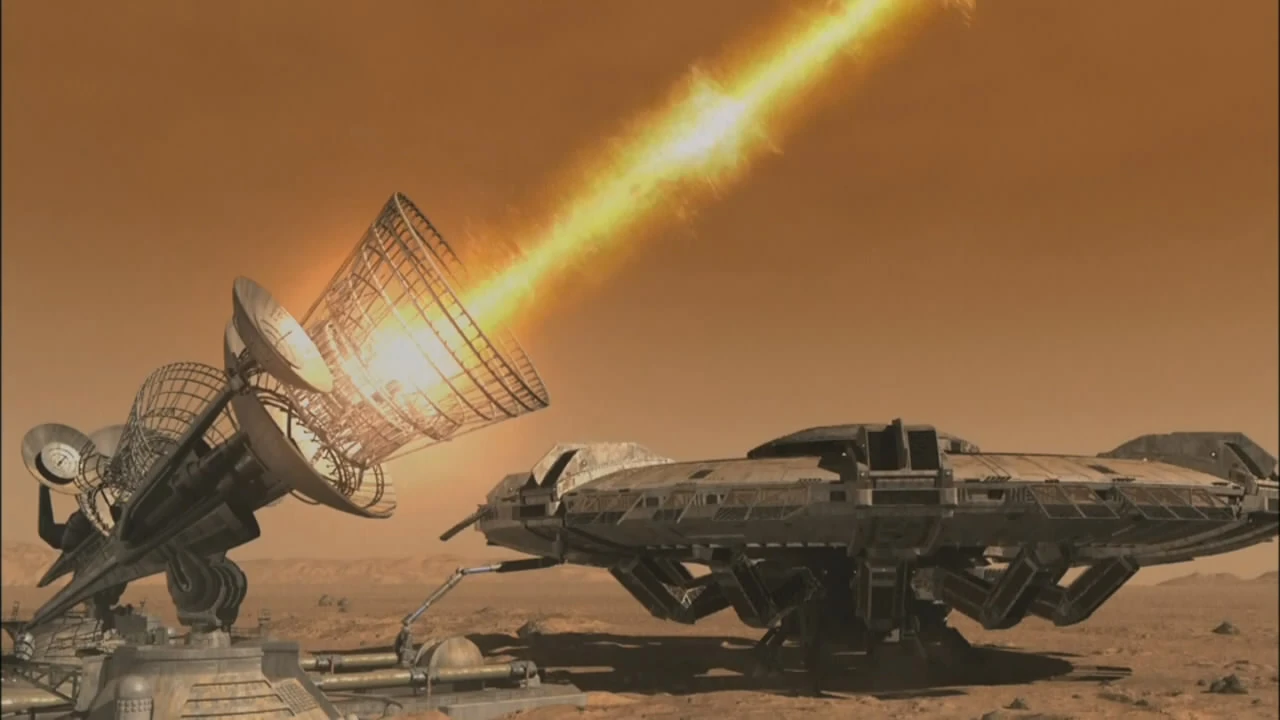


The verteron array on Mars in 2155
As of 2147 Humans had installed a verteron array to redirect comets, such as Burke, toward the polar caps for the purpose of terraforming. In 2155, Terra Prime – under the command of John Frederick Paxton – moved the Orpheus Mining Complex from Luna to Mars and hijacked the device in order to attack Starfleet Headquarters. Thanks to the efforts of Commander Charles Tucker III, the array fired harmlessly into the San Francisco Bay. (ENT: "Terra Prime")
In 2236 Mars was the intended destination of a vacation being planned by Michael Burnham and her family. The vacation was delayed because of a pending supernova. (DIS: "Lethe", "Perpetual Infinity")
In 2268, James T. Kirk argued in favor of having Sargon and his companions take over the bodies of the crew, and emphasized the benefits that it might possibly have on mankind, he explained, "they used to say if man could fly, he'd have wings. But he did fly. He discovered he had to. Do you wish that the first Apollo mission hadn't reached the moon or that we hadn't gone on to Mars or the nearest star?" (TOS: "Return to Tomorrow")
In 2274, Mars served as the launch point for the colony ship SS Artemis. (TNG: "The Ensigns of Command", okudagram)
In 2328, this was the destination of several individuals via commercial transports. Jeffrey Hanley traveled from the Hubble Deep Space Station on the SS Kogin and Brian Muirhead from Cape Canaveral, Earth on the Kogin. (TNG-R: "Inheritance", okudagram)
In 2363, on stardate 40759.5, the USS Enterprise-D was commissioned at the Utopia Planitia Fleet Yards, from where she was also launched the following year, on stardate 41025.5. (TNG: "Encounter at Farpoint" dedication plaque; TNG: "Silicon Avatar" set artwork)
In that year, a painting of Mars and its moon, Deimos, was seen in guest quarters on the Enterprise-D. (TNG: "Heart of Glory")
Prior to 2366, the Daystrom Institute of Technology established a branch on this planet. In that year, Doctor Leah Brahms was a Professor of Theoretical Physics at the institute. She resided, with her husband, at the Quayle Canals Northeast, Utopia Planitia Gardens. (TNG: "Booby Trap" okudagram)
In an another alternate timeline, Mars of 2371 was affected by the death of Gabriel Bell in 2024. (DS9: "Past Tense, Part I")
In 2372, Captain Benjamin Sisko and Constable Odo planned for Joseph Sisko and Jake Sisko to take a transport to Mars to avoid being caught in Admiral Leyton's coup d'état. (DS9: "Paradise Lost")
In 2401, Mars was listed as one of the results in Raffaela Musiker's search for the "red lady". (PIC: "The Next Generation")
The Kyrians in 3074 believed that Mars was the home of the USS Voyager, and not Earth as was the truth. A backup version of The Doctor corrected this error. (VOY: "Living Witness")


Political[]
As the first Human colony on Mars was established in 2103, the Fundamental Declarations of the Martian colonies were an important step in the pursuit of individual rights. Among the first colonists were relatives of Jean-Luc Picard. (VOY: "The 37's"; TOS: "Court Martial"; Star Trek Generations) Utopia Planitia was established along with the Utopia Planitia Fleet Yards in areosynchronous orbit above, where many famous vessels including the USS Enterprise-D, the USS Voyager, and the USS Defiant were built. Mars was also an important part in the defense of the Sol system and the location of the Mars Defense Perimeter. (TOS: "Court Martial"; TNG: "Encounter at Farpoint" dedication plaque; TNG: "The Best of Both Worlds, Part II"; Star Trek: The Next Generation Technical Manual)
Terraforming[]
Mars was the first planet to be terraformed by Humans. Colonists originally dwelt within domed cities while the verteron array was used to redirect comets and asteroids towards the Red Planet to impact in the polar caps. This freed carbon dioxide and released it into the atmosphere, increasing the planet's temperature and water volume. By 2155, conditions in the lowlands of the Martian surface were sufficiently altered to allow Humans to roam freely without heavy environmental suits, though one would still have to dress warmly for the near-arctic surface temperatures. (ENT: "Demons", "Terra Prime")
Destruction[]
- Main article: Attack on Mars
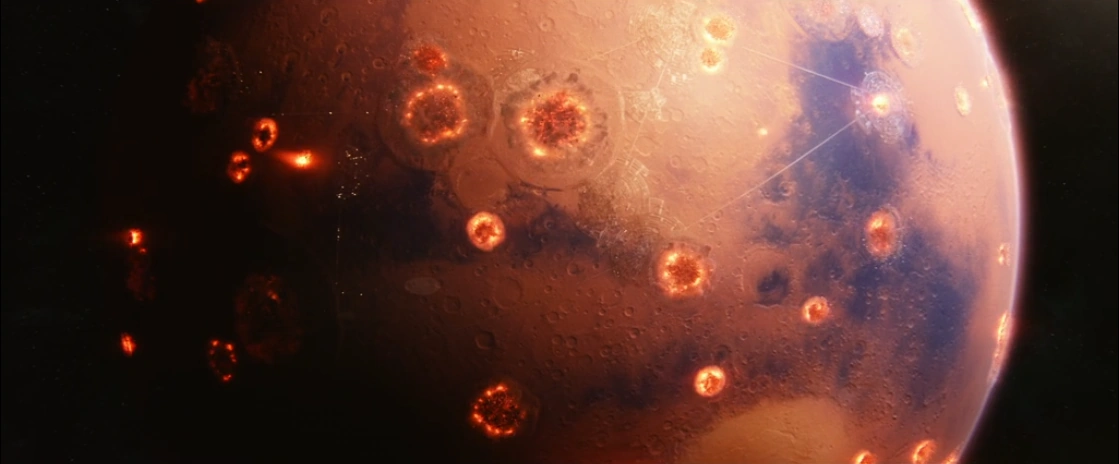

Mars under orbital bombardment
In 2385, Mars was the staging ground for a rescue armada assembled by Admiral Jean-Luc Picard to assist in the evacuation of the Romulus system due to an impending supernova. However, the planet was attacked by rogue synths who hacked into the planetary defense system, ignited the planet's stratosphere, and destroyed the armada and Utopia Planitia Ship Yards.
As of 2399, the planet's atmosphere was still burning, rendering the planet uninhabitable. This later led to some individuals, such as Agnes Jurati, to refer to that as having been "destroyed" in the attack. (ST: "Children of Mars"; PIC: "Remembrance", "The End is the Beginning")
Literature[]
Mars was often featured in science fiction stories of the 20th century. In the 1950s, the science fiction magazine Incredible Tales of Scientific Wonder featured several stories referencing Mars, such as "This Island Mars" and "Strange Martian". In 1953, Benny Russell met a vendor in Harlem who found "men from Mars" to be unrealistic. After Douglas Pabst told Russell an African-American in charge of a space station was "not believable," Herbert Rossoff angrily retorted "And men from Mars are?" (DS9: "Far Beyond the Stars")
Other references[]
A product known as Mars Toothpaste, based on the name of the Roman god, was manufactured on the fourth planet of System 892 in 2268. (TOS: "Bread and Circuses")
People[]
- Mesrop Abrahamian
- Alfonse Pacelli
- Helene Pacelli
- Salvatore Pacelli
- Lydia Romaine
- Mira Romaine
- Simon Tarses
Locations[]
- Carl Sagan Memorial Station
- Daystrom Institute annex
- Hellas Planitia
- Lower Martian plateau
- Mars City Station
- Mars Orbital Facility
- Mars Station
- Marsport
- Martian colonies
- Mons Olympus Station
- Paul Institute of Mars
- Starfleet Technical Services Academy
- Utopia Colony
- Utopia Planitia
| The Sol System |
|---|
| Sol |
| Mercury • Venus • Earth (Luna) • Mars (Deimos) • Asteroid belt • Jupiter (Io; Ganymede; Europa) • Saturn (Mimas; Rhea; Titan) • Uranus • Neptune (Triton) • Pluto |
Appendices[]
Related topics[]
- Ares IV
- Fundamental Declarations of the Martian colonies
- Mars Defense Perimeter
- Orbital glider
- Starfleet Technical Services Academy
- Verteron array
Appearances[]
- TOS:
- TNG:
- TNG films:
- DS9:
- VOY:
- "The 37's"
- "Future's End"
- "Lifesigns"
- "11:59"
- "Relativity"
- "One Small Step"
- "The Voyager Conspiracy" on astrometrics screen
- ENT:
- "Terra Nova"
- "Shockwave" (computer display)
- "Future Tense" (computer display)
- "Carbon Creek"
- "Twilight"
- "Demons"
- "Terra Prime"
- ST: "Children of Mars"
- SNW: "The Broken Circle"
Background information[]
An illusory version of Mars was originally to have featured in the first Star Trek pilot, "The Cage", with "an almost fairybook vine-covered cottage on one of the rural can-farms of Mars." The first draft story outline for "The Cage" included not only that description but also made mention of frequent Martian "hay rides," such as Barth races that the "Colonists Grange Society" was planning, as well as "a fifty-mile sled ride down the Great Slopes" on the evening after the Barth races. (The Making of Star Trek, pp. 57-58)
In a filmed but deleted Kirk voice-over which originally introduced the second pilot "Where No Man Has Gone Before", Mars was mentioned by Kirk as one of multiple "specks of dust" while the Enterprise was on a heading out of the Milky Way Galaxy. ("Where No Man Has Gone Before" (Rare and Unaired Alternate Version), TOS Season 3 Blu-ray special features)
During the early days of Star Trek, new writers repeatedly pitched story ideas that sent the Enterprise to Mars. In 1966, Gene Roddenberry stated, "We have instructed all of our writers that Mars must be avoided. It's not far-out enough for us. Our time period is 200 years from now. By that time, Mars will already have parking lot problems from Human colonists." (Star Trek Magazine issue 171, p. 40)
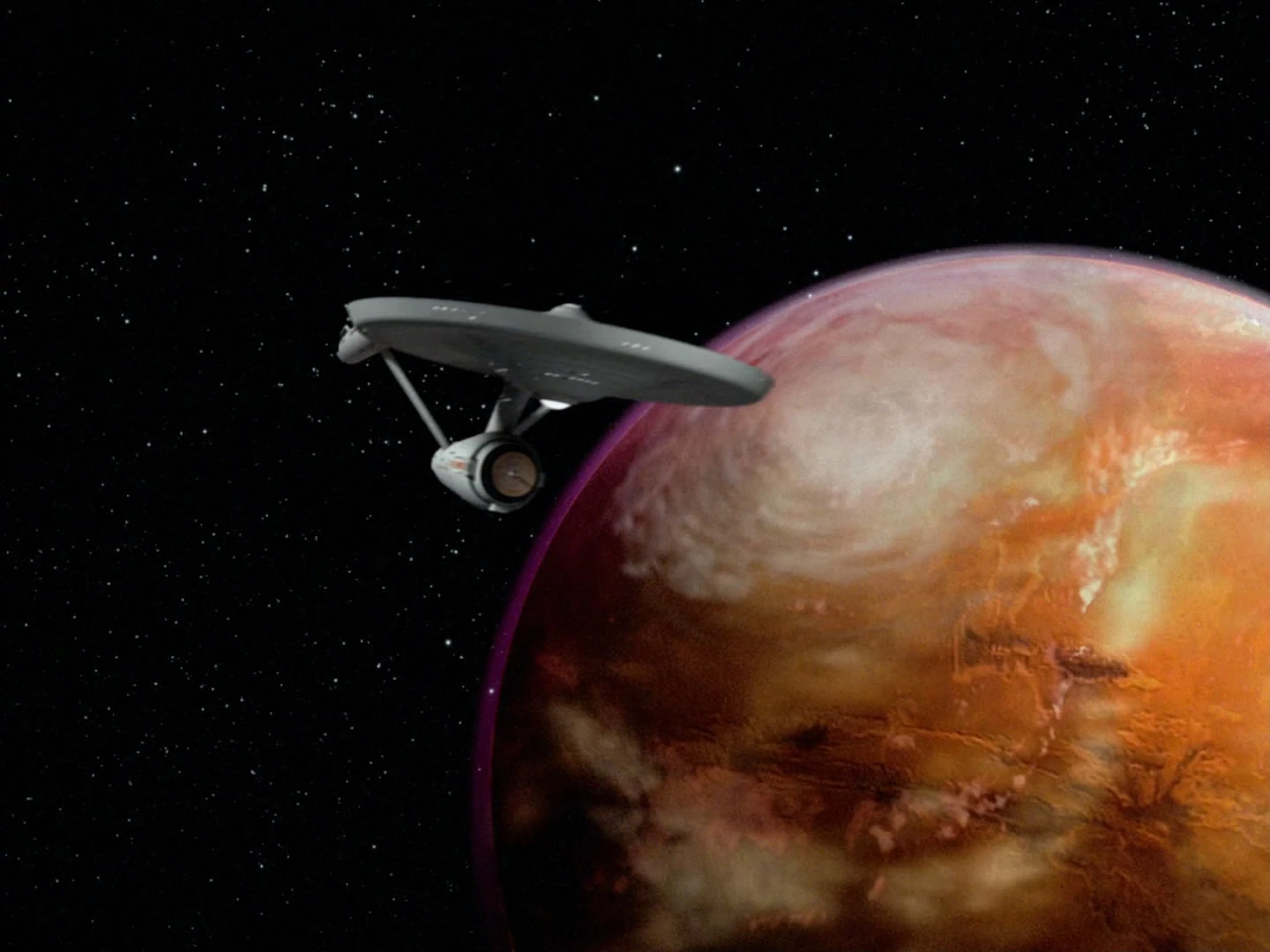

The Enterprise traveling by a planet which bears striking resemblance to Mars during the TOS opening credits of the remastered versions
The remastered versions of Star Trek: The Original Series show the prominent red planet familiar from the original opening sequence to bear striking resemblance to Mars. Indeed, the producers used real photographs of Mars as textures for this computer-generated shot, showing a large canyon, which was in fact one of the most famous landmarks on Mars: Valles Marineris, the deepest and longest canyon in the entire Sol system. Furthermore, the large cloud formation lies directly over the Tharsis plateau, which is a region of increased cloud formation on Mars, too. Whether or not the producers really intended the planet to be Mars remains unknown. However, the color of its atmosphere glows pink near the day-night boundary, which would contradict this theory, as the Martian atmosphere appears blue during sunrise and sunset. On the other hand, this change of color could be a byproduct of terraforming.
In TNG: "The Best of Both Worlds, Part II", Mars was shown without any visible surface features besides the poles. Whether intentional or not, this is very similar to the planet's appearance during a global dust storm.
In the first draft script of VOY: "Caretaker", Harry Kim mentioned that his parents had bid him farewell at the Mars colony, but the planet wasn't referenced in the episode's final draft script. [1]
The surface of Mars and Mars lander seen on an Ares IV monitor in "One Small Step" was actually a stock element from an old TV show in the Paramount library depicting the Moon, recolored and composited by Mitch Suskin's team. Mars seen from orbit was a model by Rob Bonchune. (Star Trek: The Magazine Volume 1, Issue 18, p. 29)
In the first draft script of ENT: "Strange New World", Mars was referred to as having particularly rough sandstorms, and Travis Mayweather was established as never having visited the planet. This was changed, during the episode's development, to Mayweather instead mentioning the rough conditions sure to be encountered while "flying through an ion storm at warp two."
A scene description in the final draft script of ENT: "Terra Prime" referred to "the red majesty of Mars." In another description from the same script, the planet's north polar cap was described as a "serene arctic vista".
According to Star Trek: Star Charts, (p. 32 and "United Federation of Planets I") Mars (or Sol IV) was classified as a K-class planet. In 2030, Aries I, the first manned Earth ship, landed on the planet. In 2103, the United Martian Colonies, the planetary government of Mars, was founded. Utopia Planitia was the seat of government. The first flag of the UMC was based on a painting of a bullfighter on velvet. In 2161, Mars was a charter member of the United Federation of Planets. In 2378, Humans were the dominant species on the planet and there were 133.8 million inhabitants living on Mars. Points of interest were Olympus Mons, Valles Marineris, and the Utopia Planitia Fleet Yards.
According to the Star Trek Encyclopedia (4th ed., vol. 2, p. 22), Mars orbits Sol with a mean distance of 228 million kilometers. Furthermore, it is stated, "Earth scientists first discovered microscopic evidence of ancient life on Mars in 1996." On this last point, the authors wrote,
""Future's End" and "Future's End, Part II" (VOY) were filmed in August 1996, just a few days after NASA's historic press conference announcing the discovery of possible microfossils in a Martian meteorite. Since that episode was set in late 1996, the Voyager art department put a large photo of the microfossil (with the caption "take me to your leader") as well as a newspaper clipping describing the finding into Rain Robinson's laboratory. Star Trek: Deep Space Nine scenic artist Anthony Fredrickson also commemorated the discovery by putting the code number ALH84001 on the mines laid by the Defiant in "Call to Arms" (DS9). ALH84001 was the code number of the meteorite in which the possible microfossil were found."
Roddenberry Crater on Mars is named in honor of Gene Roddenberry.
Apocrypha[]
In the Star Trek: SCE novel Aftermath, Boothby was identified as a Mars native, an homage to Ray Walston's role as the title character in My Favorite Martian.
External links[]
- Mars at Memory Beta, the wiki for licensed Star Trek works
- Mars at Wikipedia